Best ESG Reporting Software in 2026: Platforms for Disclosure, Data, and Compliance
The best ESG reporting software in 2026 compared — from investor-ready disclosure platforms to full sustainability data management systems for CSRD, CDP, and GRI.
Disclosure: This article contains no affiliate links. Tool links go directly to vendor sites.
For most of the last decade, ESG reporting was a voluntary disclosure exercise. Companies told a story they liked, investor-relations teams reviewed it, and a glossy report shipped once a year. Three regulations changed the assignment: the EU’s CSRD (in force, phased rollout running through 2028), the SEC’s climate disclosure rule, and the ISSB’s IFRS S1/S2 standards. Each requires data with an audit trail, not narrative with flexible framing.
ESG software was built for the old assignment. Most of the established platforms — even the “enterprise” ones — were architected around report production, not around the source-data lineage and reviewer controls that auditors look for under ISAE 3000. The platforms that genuinely fit the new assignment are a smaller set than the ESG software market positions itself.
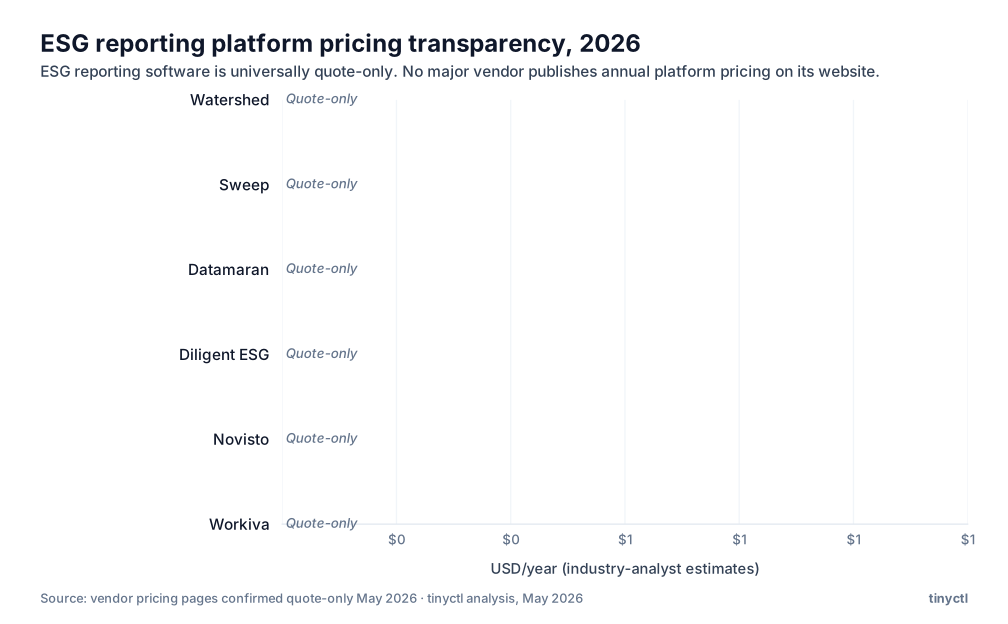
Below is the working shortlist for buyers approaching CSRD’s limited assurance bar (or the SEC’s climate rule, or the equivalent ISSB-aligned regimes that several national regulators are adopting). Pricing for this category is universally quote-only — no vendor in 2026 publishes a price for ESG reporting software, so the figures cited inline are industry-analyst estimates rather than numbers pulled from a pricing page.
Pricing at a glance
Best ESG Reporting Software in 2026 — Quick Picks
| Use case | Best pick | Why |
|---|---|---|
| Enterprise public reporting, CSRD/SEC | Workiva | Financial-grade audit trail, strongest framework breadth |
| Mid-market CSRD compliance | Novisto | Good ESRS mapping, manageable implementation |
| Board and governance-focused ESG | Diligent ESG | Strong governance integration, board reporting focus |
| ESG risk intelligence | Datamaran | Regulatory monitoring + materiality analysis, not just data collection |
| Comprehensive sustainability platform | Watershed | Carbon + ESG integrated, investor-grade methodology |
| Integrated sustainability management | ENGIE Impact or Anthesis | Full sustainability consulting + platform, suitable for complex programs |
Understanding the ESG Reporting Landscape
The framework complexity problem
One of the defining challenges of ESG reporting is that there is no single universal framework — organizations routinely report against GRI, SASB, TCFD, CDP, and now CSRD/ESRS simultaneously, because different stakeholders (investors, customers, regulators, civil society) use different frameworks. The good news is that these frameworks share many underlying data points. The bad news is that the mapping is complex enough to create significant work without software that handles it.
Regulated vs. voluntary reporting
The regulatory environment is consolidating toward IFRS-based standards (ISSB’s IFRS S1 and S2) for capital markets and ESRS (European Sustainability Reporting Standards) for EU companies. Organizations preparing for mandatory reporting need platforms that can produce audit-ready outputs aligned to these standards, not just flexible reporting templates.
The data collection problem
ESG data sits in many different systems — energy bills, HR systems, EHS software, supply chain data, procurement records, financial systems. Getting that data into one place, with consistent definitions and calculation methodologies, is the hard operational problem that ESG platforms are trying to solve. Platforms differ significantly in how much of this data collection they automate versus how much they require manual upload.
The shortlist
Workiva
Workiva is the platform most public companies already use for their 10-K and ESEF financial filings. The ESG product is the same engine with the framework mappings layered on. That’s the entire value proposition: organizations already on Workiva for SOX-grade financial disclosure can extend the same audit trail and reviewer-controls model into CSRD or SEC climate-rule reporting without rebuilding the underlying control infrastructure.
The trade-off is that Workiva is a disclosure platform, not a data collection platform. The energy bills, HR metrics, and carbon inventory still have to come from somewhere else; Workiva assembles them. Budget for both line items.
Pricing runs from roughly $80K to $250K+ a year for CSRD-scope deployments, six figures and up for large public companies. Quote-only — no published rate card. Strongest fit when audit-readiness is the primary buying criterion and a Big Four audit firm is already in the conversation.
Novisto
Novisto is the mid-market workhorse for ESG data collection done well. It handles the operational reality that ESG data sits in dozens of systems and dozens of people’s heads — the platform assigns data owners across the organization, collects inputs with commentary and evidence trails, applies validation, and maps everything to whichever frameworks the company actually reports against. CSRD/ESRS mapping is current and well-maintained.
Particularly popular in Canada and Europe, where CSRD wave 1 and 2 timing has driven a wave of practical implementations. Sustainability teams can run it without a six-month IT project, which is a meaningful difference from the enterprise tier.
Where it falls short: not at Workiva’s audit-trail depth for organizations facing the toughest CSRD limited assurance scope. Strong choice up to that threshold; verify directly if the auditor is asking specific assurance-readiness questions. Pricing is mid-market quote-only, typically in the $20K–$50K range depending on modules.
Diligent ESG
Diligent ESG sits inside the broader Diligent governance suite that boards and investor-relations teams already use. The integration with Diligent’s board portal is the differentiator — for organizations where ESG reporting is owned by governance rather than by sustainability operations, the platform lands ESG in the system the audit committee already opens on Monday mornings.
It is less mature as a data operations platform than dedicated ESG software. Sustainability teams running detailed Scope 3 inventories or EHS-driven environmental data collection will find it lighter than Novisto or Workiva.
Enterprise quote-only pricing.
Datamaran
Datamaran is in this list with an asterisk: it is not a data collection or disclosure platform. It is the regulatory and peer-intelligence layer underneath ESG reporting — what’s changing in EU, UK, US, and APAC sustainability regulation, how peers in the same SIC code are disclosing, which materiality topics are showing up in regulatory enforcement.
Buyers typically pair Datamaran with a disclosure platform like Workiva or Novisto. The Datamaran side does the regulatory monitoring and materiality input; the disclosure platform does the report production. Organizations buying only one usually pick the disclosure platform first and add Datamaran later when multi-jurisdictional reporting starts demanding more rigorous regulatory tracking than the company can do internally.
Enterprise quote-only pricing.
Sweep
Sweep combines carbon accounting and broader ESG into one platform, which makes it a useful single-vendor choice for mid-market companies that don’t want to operate separate carbon and ESG stacks. Supplier engagement workflow is solid; CDP questionnaire response is well-supported.
Weakness: not built for the audit-trail rigor that CSRD limited assurance asks for. Good fit for voluntary disclosure and CDP-driven workflows; verify assurance support specifically before relying on it for regulated CSRD reporting.
Mid-market quote-only pricing.
Watershed
Watershed started as a carbon accounting platform and has expanded into broader ESG. For tech and financial-services companies that already use it for Scope 1/2/3 inventory and want to stay on a single vendor for ESG disclosure, it’s worth the look. Full coverage of the climate side is in the carbon accounting software guide.
How this fits into the broader ESG stack
A common confusion in this category is treating ESG software as a single buy. It almost never is. The typical operating shape:
EHS software (Intelex, Cority, SafetyCulture) supplies environmental compliance and workforce safety data. Carbon accounting software (Watershed, Greenly, Sweep) supplies GHG inventory. HR systems (Workday, BambooHR, Personio) supply workforce and DE&I metrics. ESG reporting software sits on top, aggregating from all of the above into framework-mapped disclosure with audit trail.
For organizations small enough that one platform can handle data collection + reporting, an all-in-one tool may suffice. Above a certain emissions complexity or workforce headcount, separating carbon and ESG into dedicated tools — with reporting layered on top — is the more durable pattern. The break point is usually where Scope 3 starts requiring serious supplier engagement; once that’s true, carbon needs its own tool.
Things to check before signing
ESG framework versions move fast — CSRD ESRS is still settling, ISSB IFRS S1/S2 is being adopted unevenly by national regulators, and the EU 2025 Omnibus Simplification adjusted some scope. Ask each vendor what version of each standard is supported, how quickly updates ship after standards-setter publications, and what happens if you commit to a version that gets superseded mid-year.
Audit-firm familiarity matters more than feature checklists. The Big Four audit teams have built workflows around specific platforms and a learning curve around others. Ask which audit firms have signed off on CSRD or pre-CSRD ESG reports prepared in the platform you’re evaluating. A platform with established audit-firm patterns reduces first-cycle friction substantially.
Integration is where ESG software actually breaks. The platform that demos beautifully but can’t pull data automatically from your EHS, HR, and carbon systems becomes a manual-data-entry tool — and ESG data quality collapses when manual entry is the input channel. Map your existing data sources against the vendor’s integration list before any contract is signed; ask specifically about your ERP, HR platform, and carbon system rather than accepting generic “API available” reassurance.
FAQ
What is ESG reporting software?
ESG reporting software helps organizations collect, manage, and disclose environmental, social, and governance data for regulatory compliance and investor reporting. It replaces spreadsheet-based processes with structured data collection, framework mapping, and audit-ready disclosure outputs.
What frameworks does ESG software support?
Most platforms support GRI, SASB, TCFD, CDP, CSRD/ESRS, and ISSB standards. Large organizations typically report against multiple frameworks simultaneously — the platform should maintain current mapping tables as standards evolve.
Do I need ESG software or carbon accounting software?
Carbon accounting software solves one specific problem: measuring and reporting GHG emissions. ESG software covers the broader environmental, social, and governance picture. Many organizations use both — carbon accounting software feeds the environmental data into an ESG reporting platform.