Best Observability Tools in 2026: Platforms for Logs, Metrics, Traces, and Cost Control
Better Stack, Datadog, Grafana Cloud, New Relic, Dynatrace, Splunk — compared by operating model, cost structure, and team fit. A buyer's guide for platform engineers, SRE leads, and engineering managers choosing a full-stack observability platform.
Disclosure: This article contains affiliate links. We may earn a commission if you sign up through one of our links, at no extra cost to you.
TL;DR (pricing as of May 2026, checked against each vendor’s published rates): Better Stack — best default for small teams; free tier covers 10 monitors + 3 GB logs, paid telemetry starts at $30/month (Nano bundle: 40 GB each of metrics, logs, and traces with 30-day retention). Datadog — managed platform of record at enterprise scale; Infrastructure Pro from $15/host/month (annual), APM adds $31/host/month. Grafana Cloud / LGTM — best for cost control and open standards; free tier includes 10k metrics series and 50 GB logs, Pro from $19/month plus usage-based ($6.50 per 1k active series, $0.05–$0.40/GB for logs and traces). New Relic — best when ingest predictability matters; 100 GB free per month then $0.40/GB, users priced separately ($49/user for Core). Dynatrace — consumption-based with AI-assisted root cause analysis; Full-Stack Monitoring from $58/month per 8 GiB host. Splunk — log-heavy enterprise governance and security-adjacent workloads; pricing is workload, ingest, entity, or activity-based and sales-quoted only.
Pricing at a glance
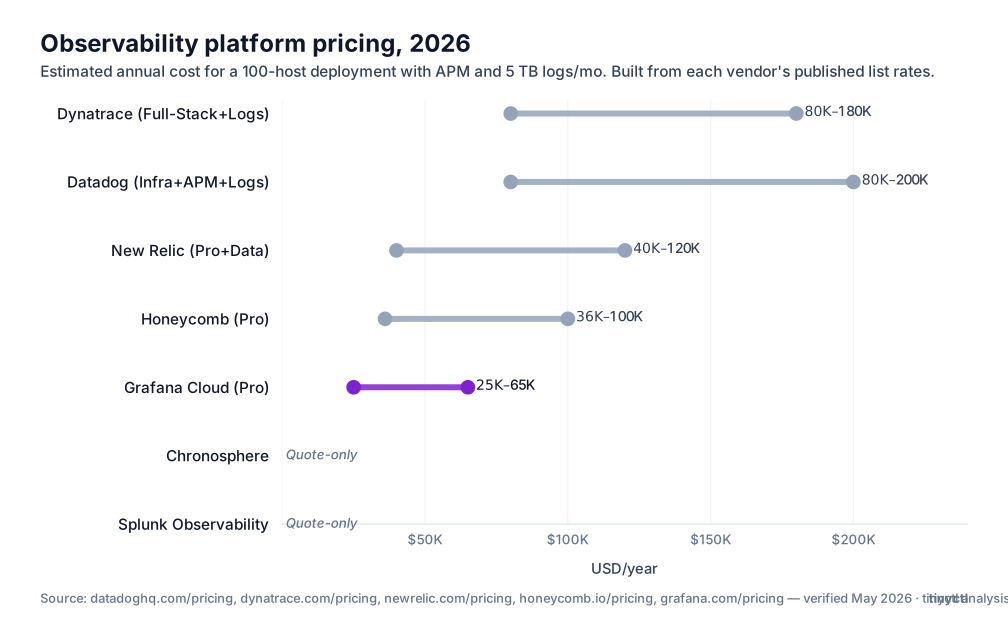
The Best Observability Tools — Quick Picks by Team Type
| Tool | Best for | Pricing model | Self-hosted |
|---|---|---|---|
| Better Stack | Smaller teams, fast time-to-value | Flat tiers from $24/mo | No |
| Datadog | Large orgs, managed breadth, deep integrations | Per host + per-SKU add-ons | No |
| Grafana Cloud / LGTM | Cost-conscious teams, open-standards stacks | Free tier; consumption-based at scale | Yes (OSS) |
| New Relic | Pricing predictability, OpenTelemetry-first teams | Data ingest (GB/mo) + seats | No |
| Dynatrace | Enterprise automation, AI root cause analysis | Per host + consumption | No |
| Splunk | Enterprise log analytics, security adjacency | Ingest-based or capacity licensing | Yes (on-prem) |
What Observability Tools Actually Need to Do
Before comparing platforms, it helps to be specific about what the job is. “Observability” has become a broad term that vendors apply to anything from uptime monitoring to security analytics — but the core function is narrower.
Metrics, logs, and traces are table stakes
A production-grade observability platform needs to collect all three signal types from your stack and correlate them under a unified query model. You need metrics for aggregate trends (error rate, p95 latency, CPU utilization), logs for detailed diagnostic context (what was the request payload, what was the exception stack trace, which user triggered the failure), and distributed traces for the critical microservices question: which service in the call graph is responsible for this slow transaction?
If your tooling covers two of the three but not the third, you have a visibility gap that will surface at the worst possible time — in the middle of an incident.
OpenTelemetry and vendor lock-in matter now
OpenTelemetry (OTel) has become the industry standard for instrumenting services to emit telemetry data. Most observability platforms now claim OTel support, but the quality varies significantly. A platform with native OTel ingestion lets you ship telemetry without vendor-specific agents, reducing the cost of switching later. A platform that requires proprietary agents for meaningful functionality creates lock-in that is expensive to unwind.
This is not a theoretical concern. Engineering organizations that have built significant operational investment in a platform — dashboards, alert configurations, runbooks built around specific query languages — face meaningful migration costs when they want to switch. If lock-in risk matters to your architecture, OTel posture should be a first-class evaluation criterion.
Cost controls are a product feature, not a finance afterthought
Telemetry costs grow faster than most teams expect. High-cardinality metrics, verbose logging in microservices architectures, and distributed traces across dozens of services compound quickly. The observability platforms that cause the most surprise renewals are the ones that charge per host, per ingested GB, and per product module separately — each additional capability adds a new line item to the invoice.
Good cost control features include: sampling controls for traces, log filtering before ingest, configurable retention policies, per-service telemetry budgeting, and pricing dashboards that let you track spend before the invoice arrives. Evaluate these before signing an annual contract, not after your first bill shock.
1. Better Stack — Best for Smaller Teams That Want Fast Time to Value
Better Stack has built one of the most developer-accessible observability products in the market. It combines uptime monitoring, structured log management, and on-call incident management in a single product at a price point that doesn’t require procurement approval to start.
What Better Stack does well:
- Fast setup, minimal agent overhead: Better Stack ingests logs via a lightweight agent, Heroku log drains, Vercel integrations, or direct API — you can get your first logs and monitors live in under 30 minutes
- Unified log search and alerting: Log tail search is fast and clean; you can build alerts on log patterns without needing to learn a specialized query language
- Incident management included: On-call schedules, escalation policies, and public status pages are bundled — you don’t need a separate PagerDuty subscription to manage incidents
- Uptime monitoring built in: Heartbeat monitoring, HTTP checks, and multi-location confirmation before alerting prevent alert fatigue while keeping detection times short
Better Stack pricing:
- Free: 10 monitors, basic log ingestion (1 GB/month), 1 on-call seat
- Hobby: $24/month — 50 monitors, expanded log retention
- Business: Custom — team collaboration, advanced alerting, extended retention
Where Better Stack falls short:
- No APM layer with distributed tracing — you can’t trace a slow transaction through a microservices call graph from within Better Stack
- Infrastructure monitoring depth is lighter than Datadog or Dynatrace for complex Kubernetes environments
- High-cardinality analytics over large log volumes is less powerful than Splunk or Elastic
Verdict: Better Stack is the right starting platform for teams under 20 engineers, early-stage products, and organizations that want to get to functional observability fast without infrastructure engineering investment. As operational complexity grows, many teams layer Better Stack’s incident management and uptime monitoring alongside a more capable APM tool rather than replacing it.
2. Datadog — Best for Managed Breadth and Deep Integrations
Datadog is the platform-of-record for large engineering organizations that want a single managed control plane across infrastructure, APM, logs, security, synthetics, and RUM. Its 700+ integrations, mature Kubernetes support, and broad product surface make it the most complete managed observability platform in the market.
What Datadog does well:
- Infrastructure monitoring depth: Container maps, Kubernetes node and pod visibility, live process tracking, and eBPF-based network performance monitoring are best-in-class for complex infrastructure
- APM and distributed tracing: Automatic instrumentation, flame graphs, service dependency maps, and database query analysis are well-executed across mainstream frameworks
- Ecosystem breadth: 700+ integrations covering every major cloud service, database, message queue, and DevOps tool — purpose-built dashboards for each rather than generic connectors
- Consolidated platform: CSPM, CI visibility, continuous profiler, synthetics, RUM, error tracking, and security monitoring all live in one billing relationship
Datadog pricing:
- Infrastructure: from $15/host/month
- APM: ~$31/host/month additional
- Logs: per GB indexed + per GB retained (separate charges)
- No meaningful free tier for production workloads
Where Datadog falls short:
- Cost unpredictability at scale: Per-host base pricing compounds with per-SKU add-ons — teams regularly report final bills 40–60% higher than initial projections
- Log cost structure: High-volume log workloads make Datadog cost-prohibitive compared to Splunk or Grafana Loki
- Agent lock-in: Proprietary agents are required for meaningful functionality; migration away is a significant engineering project
Verdict: Datadog is the right answer for large engineering organizations that need managed breadth and can absorb the cost. Budget carefully, request detailed cost modeling before signing annual contracts, and monitor your SKU expansion closely. For teams exploring alternatives, see our Datadog alternatives guide.
3. Grafana Cloud / LGTM Stack — Best for Open Ecosystems and Cost Control
Grafana Labs occupies a unique position: the open-source LGTM stack (Loki for logs, Grafana for visualization, Tempo for traces, Mimir for metrics) gives teams full observability capability at near-zero licensing cost for self-hosted deployments, while Grafana Cloud provides a managed version with usage-based pricing that can undercut Datadog substantially at scale.
What Grafana Cloud / LGTM does well:
- OpenTelemetry-native: The LGTM stack is built around open standards — OTel, Prometheus, Jaeger trace formats. You own your data and your instrumentation, and switching backends later is far less painful
- Cost transparency at scale: Grafana Cloud’s consumption model is more predictable than Datadog’s SKU expansion; self-hosted LGTM has no per-host software license cost at all
- Dashboard quality: The Grafana dashboard layer is the industry benchmark — deeply configurable, widely used, and familiar to most SRE and platform engineering teams
- Kubernetes-native logging with Loki: Loki’s label-based log indexing is designed for container workloads where Splunk-style full-text indexing is cost-prohibitive
Pricing:
- Grafana Cloud Free: 10k series metrics, 50 GB logs, 50 GB traces/month
- Pro: Usage-based — ~$8/1M series/month for metrics, ~$0.50/GB for logs
- Self-hosted LGTM: No license cost; infrastructure and operational cost only
Where Grafana falls short:
- Operational complexity: Self-hosted LGTM requires real infrastructure engineering capability to deploy, scale, and maintain. “Cheaper on paper” can become expensive in engineering time
- Enterprise support: Grafana Cloud’s enterprise support tier is less established than Datadog’s or New Relic’s for large, compliance-sensitive environments
- APM depth: Grafana Tempo for traces is solid, but the end-to-end APM experience (auto-instrumentation, code profiling, database query analysis) is less polished than Datadog or Dynatrace
For a detailed comparison between Grafana and Datadog including when each makes economic sense, see our Grafana vs Datadog breakdown.
4. New Relic — Best for Unified Full-Stack Monitoring with Strong UX Signals
New Relic’s competitive position rests on pricing predictability: a single consumption-based model where all platform capabilities — APM, infrastructure, logs, synthetics, and dashboards — are accessed through the same data-ingest pricing rather than separate SKUs.
What New Relic does well:
- Unified ingest model: APM traces, infrastructure metrics, logs, and synthetics all route through the same pipeline at ~$0.30/GB after 100 GB free/month — no feature-by-feature billing unlocking
- Generous free tier: 100 GB/month free with one full-platform user — enough for genuine production evaluation without any procurement commitment
- Native OTel support: Strong OpenTelemetry ingestion reduces vendor-specific agent dependency and preserves future flexibility
- AI-assisted analysis (NRAI): Alert correlation, anomaly detection, and AI-generated summaries are included in the base platform, not gated as add-ons
New Relic pricing:
- Free: 100 GB/month telemetry, 1 full user
- Standard: ~$0.30/GB after free tier; full users at $99/month each
- Pro/Enterprise: Volume pricing
Where New Relic falls short:
- Kubernetes and infrastructure monitoring is solid but trails Datadog on depth for complex heterogeneous environments
- Full-platform user seat pricing ($99/month each) can surprise teams with broad internal access — plan the seat model explicitly
- UI and query language (NRQL) has a steeper learning curve than Datadog’s metrics explorer for non-specialist users
5. Dynatrace — Best for Enterprise Automation and AI-Led Root Cause Analysis
Dynatrace differentiates on automation: its Davis AI engine performs automated root cause analysis, causal mapping, and anomaly detection across the full application topology. For enterprise operations teams that want observability to actively reduce mean time to resolution rather than just surface data, Dynatrace’s automation layer is meaningfully different.
What Dynatrace does well:
- Davis AI engine: Automated causal analysis that identifies root cause across topology maps — not just “here are correlated anomalies” but “this service degradation is caused by this upstream dependency failure”
- Full-stack topology mapping: Automatic discovery of service dependencies, database connections, and infrastructure relationships without manual configuration
- Deep language agent support: Dynatrace’s OneAgent provides code-level visibility across JVM, .NET, Node.js, PHP, and more with minimal instrumentation overhead
- Enterprise compliance features: Role-based access, multi-tenant environments, data residency controls, and GDPR-compliant telemetry handling for enterprise deployments
Pricing: Per-host licensing plus consumption-based components; enterprise pricing is custom. Generally positions in the premium tier above Datadog per-host.
Where Dynatrace falls short:
- Higher cost than most alternatives at equivalent scale
- Less developer-friendly for smaller teams — the platform depth is an advantage for enterprise ops teams and a source of complexity for smaller engineering organizations
- OpenTelemetry support exists but Dynatrace’s model historically centers on its proprietary OneAgent
6. Splunk — Best for Log-Heavy Enterprise Environments
Splunk’s observability capabilities are strongest in environments where log analytics, compliance retention, and security adjacency dominate the observability workload. Its Splunk Observability Cloud consolidates infrastructure monitoring and APM, but Splunk’s real moat is in log search depth and the security-observability overlap.
What Splunk does well:
- Log search power: Splunk’s SPL (Search Processing Language) and index-based architecture handle high-volume, complex log queries at enterprise scale in ways that Loki or Datadog Logs do not match
- Security adjacency: The Splunk ecosystem spans observability into SIEM (Splunk SIEM), SOAR, and threat intelligence — valuable for enterprises where security and operations share tooling
- Long-term retention and compliance: Splunk’s SmartStore and configurable indexing support compliance retention requirements (HIPAA, PCI, SOC 2) more natively than most cloud-native alternatives
- On-premises deployment: Enterprises with data residency requirements or air-gapped environments can deploy Splunk on-premises in ways that Datadog and New Relic (SaaS-only) cannot match
Where Splunk falls short:
- Cost: Splunk’s ingest-based pricing at enterprise log volumes is among the most expensive in the category — driving many teams toward Grafana Loki or Elastic as Splunk alternatives
- Complexity: Splunk requires meaningful operational investment to deploy, tune, and maintain at scale
- Developer experience: Splunk is built for operations and security analysts, not developer-first teams — the UX reflects that
For a head-to-head comparison with Datadog including when each wins, see our Splunk vs Datadog breakdown. For a broader look at log-specific tools, see our log management tools roundup.
How to Choose an Observability Tool Without Overbuying
Team size and platform maturity
The right tool is not the most capable tool — it’s the most capable tool your team can actually operate effectively. Dynatrace’s automation depth is wasted on a six-person startup that needs basic uptime monitoring and log search. Conversely, Better Stack’s lightweight model eventually shows gaps when a platform engineering team is debugging latency anomalies across twenty microservices.
A useful heuristic: if your team doesn’t have a dedicated SRE or platform engineering function, start with Better Stack or New Relic’s free tier. Migrate to Datadog or Dynatrace when the complexity of your infrastructure genuinely justifies the operational overhead and cost.
Compliance, retention, and telemetry growth
If your regulatory environment requires specific data residency, multi-year log retention, or detailed audit trails for security events — Splunk or Datadog’s compliance tier may be the only options with the features you need. Calculate retention cost explicitly: most platforms charge separately for warm retention (queryable) versus cold storage (archived), and the difference matters at high log volumes.
Telemetry volume grows faster than most teams model. A platform that looks affordable for 100 hosts at launch may look very different at 500 hosts with APM, log management, and security monitoring enabled. Always ask vendors for unit economics at projected 2-year scale, not just current scale.
When open-source actually lowers cost and when it just moves it
The Grafana LGTM stack is genuinely less expensive than Datadog on a software-licensing basis. For a team with two or three platform engineers who understand Prometheus, Loki, and Kubernetes operators, the operational cost of running LGTM is manageable and the savings are real.
For a team without that capability, the open-source stack’s “lower cost” is an accounting fiction — the engineering time to deploy, maintain, upgrade, and debug the stack is real cost that the comparison rarely counts. Before choosing open-source for cost reasons, honestly assess your team’s infrastructure engineering capacity. If you’re unsure, start with a managed offering and migrate to open-source when the business case is clearer.
For AI agent workloads that need structured telemetry in production, see our guide on monitoring AI agents in production — the observability requirements are similar but the telemetry instrumentation patterns differ.
Best Observability Platform for Logs, Metrics, and Traces in One Place
The “one platform for all three signals” question is the most common starting framing for observability evaluation. In 2026, the platforms that genuinely deliver unified logs-metrics-traces in a single product with correlated query semantics are: Datadog, Grafana Cloud, New Relic, Dynatrace, and Splunk Observability Cloud. Each takes a different architectural approach.
- Datadog and Dynatrace unify the three signals through proprietary agents and a single query layer
- Grafana Cloud unifies through the LGTM stack — separate storage backends but unified visualization and correlation
- New Relic unifies through a single data lake (NRDB) that stores all three signal types in the same backend
- Splunk Observability unifies through the Splunk Observability Cloud product, separate from Splunk Enterprise
The choice between them comes back to pricing model and operational fit, not the unified-or-not question. All five are genuinely unified in product terms; they differ in how the unification is engineered and priced.
Best Observability Platform for AI and LLM Workloads
AI and LLM applications have different observability requirements than traditional services: prompt and completion tracing, token-level cost attribution, evaluation pipelines, and model regression detection. Traditional observability platforms cover the infrastructure layer of AI workloads (GPU utilization, inference latency, request volume) but miss the model-layer concerns.
The mature pattern in 2026 is dual-stack observability: a general-purpose platform (Datadog, Grafana Cloud, or self-hosted LGTM) for infrastructure and request-level metrics, plus a specialized LLM observability tool (Langfuse, LangSmith, Helicone, Arize Phoenix, or Braintrust) for prompt traces and evaluation pipelines. See our LLM observability tools guide for a deep breakdown of the LLM-specific layer.
Datadog has added LLM observability features within its main product, but most teams running serious AI workloads still pair it with a specialized tool because the evaluation and prompt-management workflows are fundamentally different from traditional APM.
Open-Source vs Managed: How to Make the Real Cost Comparison
The list-price comparison between managed observability (Datadog at $15-$23/host/month, Grafana Cloud at usage-based pricing) and self-hosted open-source (LGTM stack, SigNoz, OpenObserve) consistently makes self-hosted look like the obvious win. The real comparison needs to count three buckets of cost:
| Cost bucket | Managed (Datadog) | Self-hosted (LGTM) |
|---|---|---|
| Software licensing | Vendor pricing | Free |
| Infrastructure (compute + storage) | Included | $5-15k/month at moderate scale |
| Engineering time to operate | Near-zero | 0.3-1.0 FTE for serious deployments |
A platform engineer’s fully-loaded cost is roughly $200-300k/year in major markets. A 0.5 FTE on observability operations is $100-150k/year — often more than the licensing savings at smaller scale. The break-even point typically arrives between 50-100 TB/month of telemetry; below that, managed usually wins on total cost.
For a deeper treatment, see our guide on the best self-hosted observability stack and how to choose between managed and self-hosted at different scale points.
FAQ
What is the best observability tool?
There is no single best observability tool. Better Stack is the strongest starting point for smaller teams: fast setup, affordable pricing, and bundled incident management. Datadog is the managed platform of record for large engineering organizations that want breadth and deep integrations. Grafana Cloud or the LGTM stack wins for cost-conscious teams with infrastructure engineering depth. New Relic earns a serious look when pricing predictability is a hard requirement.
Start by identifying your team’s operating model constraints — size, infrastructure complexity, and cost ceiling — and work backward from there.
What is the difference between observability and monitoring?
Monitoring is threshold-based: alert when a metric exceeds a predefined threshold. Observability is exploratory: collect structured telemetry so you can ask arbitrary questions about system behavior and trace failures to their root cause. In practice, modern observability platforms do both — they include monitoring alert capabilities while providing the structured logs, metrics, and traces needed for deep diagnostic work. The distinction matters most when you’re debugging an incident you didn’t anticipate and didn’t write an alert rule for.
Is Grafana an observability platform?
OSS Grafana is a visualization and dashboarding layer, not a full observability platform by itself. Grafana Cloud is a managed observability platform — it bundles Mimir (metrics), Loki (logs), Tempo (traces), and the Grafana visualization layer. When people compare “Grafana vs Datadog,” they’re usually comparing Datadog against Grafana Cloud or a self-hosted LGTM stack, not just the dashboard tool. See our Grafana vs Datadog comparison for a detailed breakdown.
Do observability tools replace log management and APM tools?
Modern full-stack observability platforms include log management and APM as integrated modules. Whether they replace standalone tools depends on depth requirements and cost. Datadog’s APM and log management are capable replacements for most mid-market workloads. Splunk’s log search depth and Elastic’s full-text indexing power exceed what most observability platforms offer as bundled features. Many teams run a primary observability platform for general telemetry and a specialist tool for workloads where depth justifies the additional cost.