Best LCA Software in 2026: Life Cycle Assessment Tools for Product Carbon Footprints
The best LCA software in 2026 compared — life cycle assessment tools for product carbon footprints, environmental product declarations (EPDs), and ISO 14040/14044-compliant impact studies.
Disclosure: This article contains no affiliate links. Tool links go directly to vendor sites.
LCA software supports the methodology specified in ISO 14040 and 14044: assessing the environmental impacts of a product or process across its life cycle, from raw material extraction through end-of-life. The output isn’t a single carbon number; it’s a multi-category impact assessment that’s defensible against third-party critical review.
Two market forces are pushing buyers into this category in 2026. The EU Green Claims Directive raises the bar for environmental marketing — vendors who want to say “low carbon” or “sustainable” about a specific product increasingly need a defensible LCA behind that claim. And the EU Ecodesign for Sustainable Products Regulation is adding mandatory product-level environmental data requirements that previously sat at the corporate level.
The category splits into two markets that don’t look alike from the inside. Traditional LCA practitioner tools (SimaPro, openLCA, Sphera’s GaBi) are sold to LCA specialists with formal methodology training. Newer product-focused platforms (Makersite, One Click LCA, Ecochain) are sold to design engineers and sustainability teams that need to embed LCA into product decisions without a specialist headcount. Both ship in this guide; the right choice depends on which workflow the buyer actually has.
Pricing at a glance
Best LCA Software in 2026 — Quick Picks
| Use case | Best pick | Why |
|---|---|---|
| Industrial and complex products | Sphera (GaBi) | Deepest emission factor library, enterprise-grade |
| LCA practitioners and consultants | SimaPro | Standard professional LCA software, broad database support |
| Open source / academic / starter | openLCA | Free, ISO-conformant, ecoinvent and other databases |
| Built environment and construction | One Click LCA | Strong EPD generation, construction-specific factors |
| Product design and CAD-integrated | Makersite | Material-level depth, ERP and PLM integration |
| Apparel and consumer goods | Worldly (formerly Higg) | Higg Index methodology, apparel supply chain depth |
| Manufacturing PCF at product portfolio scale | Ecochain | Mid-market manufacturing focus, portfolio-level scaling |
How LCA Software Differs From Other Sustainability Tools
Functional unit, not company
Where carbon accounting software calculates a company-wide GHG inventory, LCA calculates impacts of a defined functional unit — “1 kg of cement”, “1 km of vehicle operation”, “1 garment worn for 100 wears”. This product-or-process granularity is the central methodological difference and drives different data needs.
Multiple impact categories
A carbon footprint reports CO2-equivalent climate impact. A full LCA produces 15–20 impact categories including climate change, eutrophication, acidification, water consumption, particulate matter, and resource depletion. Regulations increasingly require multi-category impact assessment, not just carbon, to prevent burden-shifting.
Methodology is contested
LCA results depend on choices: system boundaries, allocation methods, impact assessment methods (CML, ReCiPe, EF 3.1), and database selection. Two analysts can produce different impact results for the same product with defensible methodology on both sides. Software needs to support methodology documentation and sensitivity analysis to make studies reproducible and credible.
Database licensing is separate from software
Most LCA software is sold separately from the underlying emission factor databases. Ecoinvent, GaBi databases, and ELCD have their own licensing. Total cost of ownership requires combining software and database licensing.
The shortlist
Sphera (GaBi)
Sphera — which acquired GaBi from thinkstep — is the enterprise standard for industrial and complex-product LCA. The GaBi database is among the most comprehensive sources of industrial-process emission factors anywhere, particularly for metals, plastics, energy systems, and discrete manufacturing processes. The platform scales to product models with thousands of processes without falling over.
Automotive, aerospace, electronics, and industrial manufacturing sectors live here. Methodology support for ISO 14040/14044 conformance and third-party critical review is mature, which is the thing that actually matters for studies destined for regulatory submission, EPDs, or comparative claims under the EU Green Claims Directive.
The cost is implementation effort. Sphera rewards organizations with in-house LCA capability or a serious consulting relationship and punishes the ones expecting plug-and-play.
Enterprise quote-only — industry estimates put it $30K–$100K+/year depending on user count, modules, and database scope, often higher with full GaBi database access.
SimaPro
SimaPro is the practitioner workhorse. Independent of any single database vendor — supports ecoinvent, ELCD, and most other major libraries — and it’s the LCA software most consultants and academic researchers are already trained on. That training portability matters: an LCA practitioner moving between a consulting role and an in-house position can take SimaPro skills with them and stay productive on day one.
Methodology flexibility is the technical strength — CML, ReCiPe, EF 3.1, IPCC, and other impact assessment methods are all supported, which matters for studies that need a specific method (EF 3.1 for EU PEF studies, ReCiPe for biodiversity-related work, IPCC for climate-only).
The trade-off is integration. SimaPro lives on the practitioner desktop rather than in PLM or ERP workflows, which is appropriate for its target use but limiting if the buyer wants LCA embedded in product design decisions.
Per-user-year licensing, typically $3,500–$10,000+/user-year. Database licensing — ecoinvent at roughly $3K–$5K/user-year — is separate and recurring.
openLCA
openLCA is the free, ISO-conformant LCA tool developed by GreenDelta. Free software, paid databases. It’s a real LCA tool, not a stripped-down educational version — fully usable for production work, supports the major impact assessment methods, conforms to ISO 14040/14044.
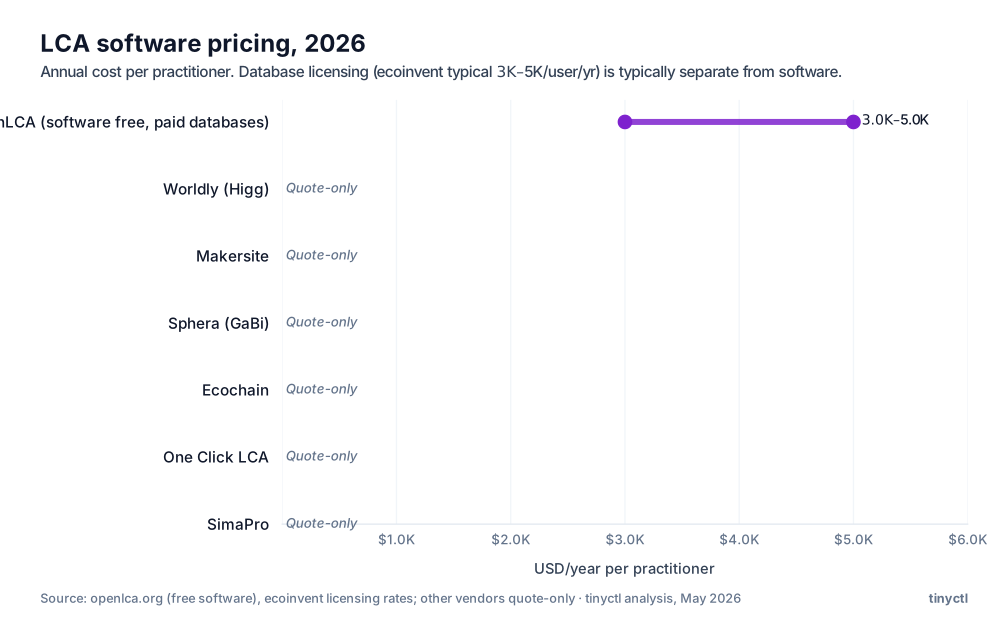
The catch with “free LCA software” is that LCA isn’t free. The emission factor databases are the substantive cost: ecoinvent licensing runs $3K–$5K per user per year, and that’s the database most serious LCA work depends on. The software being free shifts the budget conversation, but it doesn’t remove it.
Strong choice for academic use, capability-building in organizations new to LCA, and teams cost-constrained on software but able to invest in database access and methodology training. The UI is less polished than SimaPro and the community is smaller, which limits the available training resources outside the open-source documentation.
One Click LCA
One Click LCA owns the built environment — buildings, infrastructure, construction products. Construction-specific emission factor coverage is the differentiator, along with native EPD generation that’s recognized by EPD program operators in the building sector.
Building-LCA-driven green certifications (BREEAM, LEED, DGNB) are what most One Click LCA users are working toward. The platform’s energy modelling integration for whole-building LCA, combined with construction-material factor depth, makes that workflow tractable.
Outside the built environment, it’s the wrong tool. Cross-sector general industrial LCA is better served by SimaPro or Sphera.
Mid-market pricing, typically $5K–$30K/year depending on modules and users.
Makersite
Makersite approaches LCA from the PLM/ERP integration side. The design intent is to bring LCA into product design and engineering workflows rather than have it live in a separate sustainability silo — material-level depth, supply chain data handling, integration with PLM systems like PTC Windchill and Siemens Teamcenter.
The target use case is design-stage LCA where alternative material decisions are still possible to make. A design engineer choosing between two material specifications can see the comparative LCA impact at decision time, rather than getting a sustainability team’s after-the-fact assessment of a product that’s already been engineered.
Less established in the academic and consulting LCA community than SimaPro or openLCA. Methodology flexibility for non-standard impact assessment methods is more limited.
Enterprise quote-only.
Worldly (formerly Higg)
Worldly is the apparel and footwear sector tool, built around the Higg Index methodology developed by the Sustainable Apparel Coalition. It’s the industry standard for that sector’s supply chain sustainability assessment — material, manufacturing, and facility-level data, with a strong network effect because most major apparel brands and suppliers are already on the platform.
Sector-specific by design. Not suitable for non-apparel applications. The Higg methodology has had public critique on certain points, so verify current alignment with broader LCA standards before relying on Higg-derived numbers for specific external claims.
Quote-only pricing tied to the apparel ecosystem.
Ecochain
Ecochain targets mid-market manufacturers that need LCA at product portfolio scale — many SKUs, regular updates, manufacturing-data-driven inputs. The positioning is between the spreadsheet-era approach and the enterprise complexity of Sphera: more rigorous than DIY, lighter than a full LCA-practitioner deployment.
Strong fit for manufacturers whose customers — typically retailers or B2B buyers with their own sustainability programs — are demanding product carbon footprint data across an SKU portfolio. The platform handles repeatability across many products, which is where spreadsheet-based PCF programs collapse.
Less methodology depth than SimaPro or Sphera for complex critical-reviewed studies. Better as a portfolio workhorse than a research-grade tool.
Mid-market quote-only pricing — industry estimates around $10K–$40K/year.
Methodology
This guide reviews LCA software positioned for production use as of May 2026. Pricing reflects publicly available reporting and industry estimates; most vendors except open-source openLCA price by quote with no public price lists. Database licensing (ecoinvent in particular) is typically a separate substantial cost from software licensing — total LCA cost of ownership requires combining both. Methodology and impact assessment method support varies by software release; verify current capabilities before purchase.
How LCA Software Fits Into the Broader Sustainability Stack
LCA software is one tool in a multi-tool sustainability stack:
- LCA software (Sphera, SimaPro, openLCA, One Click LCA) for product-level life cycle impact assessment
- Carbon accounting software (Watershed, Greenly, Sweep) for organizational GHG inventory
- Scope 3 emissions tools (Persefoni, Avarni) for value chain emissions at organizational scale
- ESG reporting software (Workiva, Position Green) for disclosure framework reporting
- PLM/ERP (PTC Windchill, SAP, Siemens Teamcenter) as data source for materials and bills of materials
Product carbon footprints calculated in LCA software can feed organizational Scope 3 inventories at the supplier-specific data quality tier — bridging product-level rigor into corporate-level disclosure.
What to Verify Before Buying
Database access and total cost
Verify which emission factor databases are included, which require separate licensing, and what total cost of ownership looks like with software plus databases plus support. Ecoinvent licensing in particular is a recurring cost.
Impact assessment method support
If you need specific methods (EF 3.1 for EU PEF studies, ReCiPe for biodiversity-related assessments, IPCC for climate-only), verify support. Generic “supports LCA” claims hide variation in method depth.
Conformance and critical review
For studies that need third-party critical review (regulatory submission, comparative claims, EPDs), verify the software’s track record of supporting ISO 14040/14044-conformant studies with documented critical review.
Workflow integration
For product-design integration, verify CAD, PLM, and ERP integration depth specifically. Generic “API available” is not the same as production-grade integration.
FAQ
What is LCA software?
Software supporting the ISO 14040/14044 life cycle assessment methodology — process modelling, impact assessment, and emission factor databases — to calculate the environmental impact of products or processes across their full life cycle.
How is it different from carbon accounting software?
Carbon accounting calculates company-wide GHG inventory at organizational boundary. LCA calculates product or process impact at functional unit boundary across the full life cycle, typically across multiple impact categories beyond just carbon.
Do I need it or is a carbon footprint calculator enough?
Simplified carbon calculators may suffice for single-category claims at low rigor. Full LCA software is required for multi-category impact, third-party verified claims, EPDs, and design-stage decision support — increasingly the regulatory standard.
How much does it cost?
openLCA: free software, paid databases (~$3,000–$5,000/user-year for ecoinvent). SimaPro: $3,500–$10,000+/user-year plus databases. One Click LCA, Ecochain: $5,000–$30,000/year. Sphera and other enterprise: $30,000–$100,000+/year. Database licensing is typically separate from software.