Best MES Software in 2026 for Manufacturers That Need More Than ERP Alone
The best MES software in 2026, compared by manufacturing environment — from discrete and regulated production to mid-market plants that have already hit the limits of ERP.
Note: This article does not contain affiliate links for the products reviewed. We cover MES software editorially because manufacturing execution decisions are high-stakes and we have not verified a commercial relationship with any of the core vendors in this category.
Most articles about MES software make the same mistake: they list the products before explaining the problem. A manufacturer who does not yet understand what MES is supposed to own — and where ERP stops — cannot make a good decision from a ranked product table.
This article is structured around the system boundary first. If you already know you need MES, you will find the platform comparison useful. If you are not sure whether you need MES or whether better ERP configuration would solve your problem, read the first section before anything else.
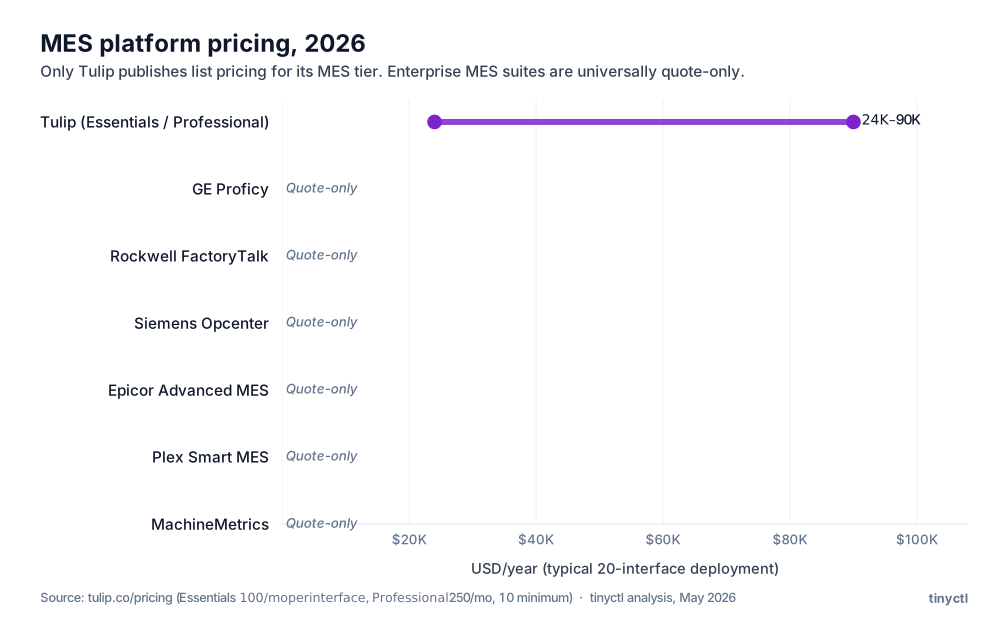
Pricing at a glance
The Best MES Software in 2026 — Quick Picks by Manufacturing Environment
| Manufacturing environment | Best pick | Why |
|---|---|---|
| Discrete manufacturing, enterprise scale | Siemens Opcenter | Deep integration, broad module set, strong for regulated and complex production |
| Connected plant, Rockwell infrastructure | Rockwell FactoryTalk / Plex MES | Native to Rockwell ecosystems; Plex adds cloud deployment |
| Fast deployment, operator-first workflows | Tulip | No-code platform builder, operator adoption-first, strong for mid-market |
| Mid-market discrete with Epicor ERP | Epicor Advanced MES | Clean ERP integration, practical production floor capabilities |
| High-mix, regulated, or semiconductor production | Critical Manufacturing | Purpose-built for complex traceability and multi-level genealogy |
| Aerospace, defense, automotive, regulated global ops | DELMIA Apriso | Strong for global multi-plant rollouts and regulatory compliance |
What MES Software Should Solve That ERP Usually Does Not
Understanding this distinction is more valuable than any product comparison. The decision to buy MES is the decision that ERP is not tracking something important enough, fast enough, or with the right granularity.
Work order execution on the floor
ERP issues a work order. MES tracks what happens to it: which operator picked it up, what machine it ran on, what materials were consumed at which step, whether it passed or failed quality checkpoints along the way, and what the actual versus planned cycle time was. Without MES, this information lives in paper travelers, operator memory, or not at all — which means ERP’s production records reflect what should have happened, not what did.
The consequence shows up in warranty claims, scrap accounting, lead time accuracy, and labor productivity analysis. Manufacturers who cannot close the loop between planned work orders and actual production outcomes typically cannot diagnose whether schedule misses come from capacity, materials, quality, or operator bottlenecks.
Real-time production visibility
ERP gives you the plan. The production floor gives you reality. In plants without MES, the gap between those two things is filled with manual updates, end-of-shift reporting, or nothing at all. Supervisors walk the floor to understand what is actually happening. Scheduling decisions are made on stale data.
MES captures work-in-progress in real time: which jobs are running, which are queued, which are blocked, and why. That visibility changes both day-to-day operations and the quality of production planning decisions upstream.
Traceability, quality, and downtime accountability
In regulated industries — medical devices, food and beverage, aerospace, pharmaceuticals — traceability is not optional. Every unit needs a recorded chain: which materials came from which lot, which operators touched which step, which equipment was used. MES creates that record at the point of production, not after the fact. In a recall or audit, that record is the difference between a manageable investigation and an uncontrolled one.
Even in non-regulated environments, quality accountability matters. When a batch of defective product ships, the question is always: where did it go wrong, and what else was affected? Without MES, answering that question is an archaeological exercise.
The Best MES Platforms Compared
Siemens Opcenter
Siemens Opcenter is the flagship MES/MOM platform from Siemens Digital Industries Software, incorporating what was previously Camstar MES and Manufacturing Operations Center. It is one of the most complete manufacturing operations platforms available, covering execution, quality, production intelligence, and advanced planning within a unified product family.
What it does well: Opcenter is deep. The execution module handles work order management, labor tracking, material genealogy, quality enforcement, and equipment integration in a way that few competing platforms match in breadth. The Opcenter APS module covers finite-capacity scheduling, which means manufacturers can close the loop between scheduling and execution within the same vendor ecosystem. For regulated manufacturers — medical devices, aerospace, automotive — Opcenter’s quality management and electronic device history record capabilities are proven at scale.
Who it is for: Large discrete manufacturers with complex production, regulated environments requiring audit-ready traceability, and manufacturers who can invest in a structured implementation program. Opcenter is not a fast-start tool — the deployment requires scoped configuration work and often an implementation partner.
Honest limitation: Siemens Opcenter’s breadth is also its complexity. Smaller manufacturers or those without dedicated manufacturing IT resources can find the platform difficult to configure and maintain. The value is highest when the manufacturing operations are genuinely complex enough to justify the implementation scope.
Pricing: Enterprise pricing, no public rates. Implementation typically requires a system integrator engagement.
Rockwell FactoryTalk / Plex MES
Rockwell Automation’s MES offering spans two product lines: FactoryTalk, which is the established on-premises industrial platform with deep PLC and SCADA integration native to Rockwell hardware environments, and Plex Manufacturing Cloud, acquired by Rockwell in 2021, which is a cloud-native MES and ERP platform built for discrete and process manufacturers.
What it does well: For manufacturers already running Rockwell PLCs, drives, and control infrastructure, FactoryTalk integration is a genuine structural advantage — data flows from the control layer up into MES without the integration work that other platforms require. Plex MES adds cloud deployment and a cleaner ERP integration story for manufacturers who want a more modern architecture.
Who it is for: Rockwell-infrastructure plants where native control-to-MES data flow is a priority, and mid-to-large discrete manufacturers considering cloud-first MES deployment. Plex MES is particularly relevant for manufacturers who want a unified ERP and MES platform on a single cloud deployment.
Honest limitation: FactoryTalk’s strengths are most pronounced in Rockwell-heavy environments. In mixed-vendor control environments, the integration advantage diminishes and the platform becomes harder to justify versus alternatives. Plex MES is a younger platform and the integration between the legacy Rockwell portfolio and the Plex cloud product is still maturing.
Pricing: Enterprise pricing, requires direct vendor engagement.
Tulip
Tulip is a cloud-based manufacturing operations platform built around the concept of no-code “apps” — digital work instructions, quality checklists, operator interfaces, and production tracking applications that frontline teams can build and modify without software development. It is the most deployment-accessible option in this category.
What it does well: Tulip’s core strength is operator adoption speed. Unlike traditional MES platforms, which require heavy IT configuration before frontline workers see any benefit, Tulip is designed so that process engineers and plant managers can build useful apps in days. The platform connects to machines via IoT sensors and edge devices, captures production data in real time, and surfaces it in dashboards — without needing a full-scale MES implementation program.
Who it is for: Mid-market discrete manufacturers looking to digitize paper-based production workflows without the complexity and cost of enterprise MES. Also a strong fit for manufacturers who have specific high-priority gaps — quality check digitization, work instruction standardization, real-time station-level tracking — and want to solve them incrementally rather than committing to a full MES replacement program.
Honest limitation: Tulip is not a full MES in the traditional sense. It does not replace an ERP’s work order management backbone — it extends it with operational data capture and operator-facing tooling. Manufacturers who need deep genealogy traceability, complex multi-step routing management, or full quality record management at scale should evaluate traditional MES platforms alongside Tulip.
Pricing: Subscription pricing. Starts in the range of platform-plus-edge-device costs — the company does not publish per-seat rates publicly, but it is significantly more accessible than enterprise MES licensing.
Epicor Advanced MES
Epicor Advanced MES (previously known as JobScope and now part of the Epicor Kinetic ecosystem) is designed for discrete manufacturers and job shops that are already running or considering Epicor ERP. It covers work order execution, quality tracking, labor data capture, and shop-floor visibility in a package designed to integrate closely with Epicor’s ERP and financial management.
What it does well: For manufacturers in the Epicor ecosystem, Advanced MES provides the shop-floor execution layer without requiring a separate vendor integration. The work order and inventory data flows between Epicor ERP and MES natively, which reduces the reconciliation work that typically consumes manufacturing IT time. The platform is practical and focused on the specific problems discrete manufacturers face: job tracking, routing management, quality disposition, and labor accountability.
Who it is for: Mid-market discrete manufacturers, job shops, and custom manufacturers who are already running Epicor Kinetic (or evaluating it) and want a connected shop-floor execution layer.
Honest limitation: Epicor Advanced MES is valuable within the Epicor ecosystem and limited outside of it. If you are not an Epicor ERP user and are evaluating standalone MES options, the platform’s advantages largely disappear.
Pricing: Enterprise pricing tied to Epicor licensing. Direct vendor engagement required.
Critical Manufacturing
Critical Manufacturing is an MES platform built specifically for high-complexity discrete manufacturing — semiconductor, electronics, medical devices, and aerospace. Its architecture is designed around multi-level traceability, complex routing, equipment integration, and quality management at the genealogy level required in the most regulated manufacturing environments.
What it does well: In high-mix, complex production environments where every unit needs a complete genealogy record, Critical Manufacturing’s data model is purpose-built. The platform handles complex routing with conditional branching, multi-level material genealogy, and rich quality disposition workflows in ways that general-purpose MES platforms struggle to match for the most complex traceability requirements.
Who it is for: Manufacturers in semiconductor, medical device, aerospace, and electronics where per-unit or per-lot traceability at every step is a regulatory and operational requirement. Not a fit for simpler discrete or process manufacturers who would be buying complexity they do not need.
Pricing: Enterprise pricing, implementation-heavy. No public rates.
DELMIA Apriso
DELMIA Apriso is Dassault Systèmes’ global manufacturing operations management platform, designed for large multi-site manufacturers who need to standardize and connect plant operations across multiple facilities and geographies.
What it does well: Apriso’s core strength is global standardization. For manufacturers with 5, 10, or 20 plants in multiple countries, Apriso provides a platform that can enforce standard work instructions, quality processes, and production reporting across all facilities while accommodating local regulatory and operational differences. The platform connects into the Dassault 3DEXPERIENCE ecosystem for manufacturers who also use CATIA or ENOVIA for design and PLM.
Who it is for: Large multinational discrete manufacturers — typically automotive, aerospace, defense, or industrial equipment — who have both the complexity to justify global MES deployment and the IT infrastructure to support it. This is not a mid-market product.
Honest limitation: Apriso is purpose-built for global enterprise manufacturing operations. The complexity, cost, and implementation scope reflect that. Manufacturers who are not genuinely global in their production operations are likely to find simpler, more cost-effective MES options better matched to their actual needs.
Pricing: Enterprise, requires direct Dassault engagement. Substantial implementation investment expected.
MES vs ERP vs SCADA vs Scheduling Software
This is the question that actually drives most MES evaluations, and most articles skip over it entirely.
Where ERP remains the system of record
ERP is not going away when you add MES. It remains the authoritative record for inventory quantities, bill of materials, purchase orders, finished goods, and the financial record of what was produced and at what cost. MES consumes ERP data (work orders, BOMs, routing) and writes back production actuals (quantities completed, materials consumed, labor hours, quality results). The two systems should work together — not replace each other.
If your question is “should I replace my ERP with an MES,” the answer is no. MES does not manage purchasing, accounts payable, customer invoicing, or the business system of record. It manages what ERP cannot reach: the execution detail of what actually happened on the production floor.
Where SCADA stops
SCADA software captures machine signals, sensor readings, and control states in real time. It is the layer that knows a machine is running at 87% efficiency, that a temperature exceeded a threshold, or that a conveyor stopped. SCADA does not know what work order that machine is executing, whether the part being produced passed quality inspection, or which operator is responsible for the current shift. That is MES territory. In plants that have both, SCADA data feeds upward into MES where it becomes part of the production record.
Where scheduling software is enough
Manufacturing scheduling software addresses finite capacity planning — given available machines, labor, and materials, what is the optimal sequence and timing of production jobs? That is a planning problem, not an execution problem. Some manufacturers genuinely need better scheduling without needing full MES — if your primary pain is schedule accuracy and lead time reliability, not shop-floor data capture and traceability, a dedicated scheduling tool may solve the problem more efficiently. The two layers are complementary, and the most capable manufacturers typically run both.
How to Choose Without Overbuilding the Stack
Plant complexity and rollout scope
The single most important variable in MES selection is the gap between your current floor-level data quality and the state you need to operate reliably. If that gap is modest — a few digital forms to replace paper travelers, basic work order status tracking — simpler tools like Tulip or lightweight MES modules within an existing ERP may be enough. If the gap is structural — complex multi-step routing, regulatory traceability, full quality management, high-volume production accounting — then dedicated enterprise MES is the appropriate investment.
Integration with ERP, quality, and maintenance workflows
MES sits in the middle of the manufacturing stack, which means integration requirements are real in both directions. Upward, it needs to receive work orders, BOMs, and scheduling inputs from ERP — and write back production actuals. Downward or laterally, it typically needs to connect to machine monitoring, quality management, and CMMS software for maintenance event tracking. Evaluate integration architecture before finalizing a platform selection, not after.
If your production workforce capacity is a constraint in scheduling and execution, your workforce planning software and labor data flows should also be considered in the MES architecture.
Operator adoption and implementation risk
The most underrated risk in MES implementations is operator adoption failure. A system that engineers design and operators refuse to use produces worse outcomes than the paper-based system it replaced, because now you have both the process friction and the illusion of data quality. Platforms like Tulip are specifically designed to make adoption the primary metric. Enterprise platforms like Opcenter and Apriso require deliberate change management programs alongside technical implementation.
For production analytics and business intelligence on top of MES data, plan the reporting layer as part of the initial architecture — not as a follow-up project.
FAQ
What is the best MES software? See the quick picks table at the top of this article. The answer depends on your production environment, existing technology stack, industry, and implementation capacity. Siemens Opcenter and FactoryTalk/Plex are the dominant enterprise options. Tulip is the most deployment-accessible mid-market option.
What is the difference between MES and ERP? ERP manages the business system of record — what should happen, what it should cost, and what the financial result is. MES manages execution — what is actually happening on the floor, with what materials, by whom, and with what quality result. MES reads from ERP and writes back production actuals. The two are complementary, not substitutes.
Do small manufacturers need MES software? Most do not. Under roughly 50 employees or with simple production flows, better ERP configuration or lightweight production tracking tools are usually sufficient. MES becomes necessary when traceability requirements are regulatory, when the gap between planned and actual production is costly and invisible, or when complex multi-step routing needs real-time management.
Is MES the same as SCADA? No. SCADA is a machine and process monitoring layer. MES is a production execution and accountability layer. SCADA tells you what machines are doing. MES tells you what is being made, whether it meets quality standards, and which work order it belongs to. In a full industrial stack, SCADA data feeds upward into MES.