Best Warehouse Management Systems (WMS) in 2026: Picks by Operation Type
Compare the best warehouse management systems in 2026 — Manhattan Associates, Blue Yonder, SAP EWM, Infor WMS, NetSuite WMS, Logiwa, Extensiv, Fishbowl, and Softeon — by operation size, 3PL vs in-house, and integration with ERP and shipping.
Note: This article does not contain affiliate links. WMS purchases are high-stakes operational decisions and we cover this category editorially.
Most WMS comparisons skip the question that actually determines the right answer: what kind of warehouse are you running. An enterprise distribution center with 200 pickers and conveyor automation, a 3PL serving forty customer brands, an e-commerce fulfillment operation feeding shipping APIs, and a manufacturing-attached finished-goods warehouse have almost nothing in common at the WMS layer.
This guide is organized by operation type first. Pick your row in the table below, then read the section that matches it.
Pricing at a glance
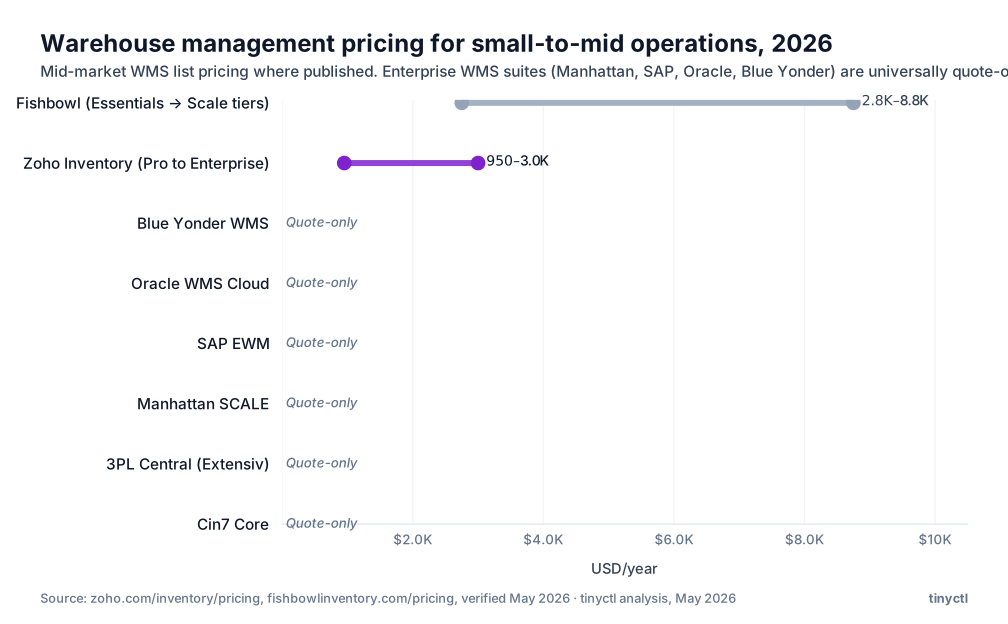
The Best WMS in 2026 — Quick Picks by Operation Type
| Operation type | Best pick | Why |
|---|---|---|
| Enterprise multi-site distribution | Manhattan Associates Active WM | Deepest labor management, slotting, and complex DC workflows |
| Connected supply chain, large enterprise | Blue Yonder WMS | Tight integration with Blue Yonder planning suite |
| SAP-native enterprise | SAP EWM | Native S/4HANA integration, full process model |
| Mid-market distribution, food, 3PL | Infor WMS | Strong vertical depth in food, beverage, and pharma distribution |
| NetSuite-attached operation | NetSuite WMS | Cleanest pick for NetSuite ERP users |
| Cloud-native 3PL | Extensiv (fmr. 3PL Central) | Purpose-built for multi-client 3PL operations |
| E-commerce fulfillment, 3PL or DTC | Logiwa | Cloud-native, strong shipping API integrations |
| SMB manufacturing or distribution | Fishbowl | Affordable, QuickBooks-friendly, mature feature set |
| Enterprise WMS with deep automation | Körber WMS (HighJump) | Strong material handling equipment integrations |
What a WMS Should Solve That an Inventory System Does Not
An inventory management system is a record of what you have and where it is at a high level. A warehouse management system is a control system for how the warehouse actually operates. The decision to buy a WMS is the decision that warehouse operations are losing efficiency or accuracy that the inventory system cannot see.
Bin-level location accuracy
Inventory systems usually track stock by warehouse or by zone. WMS tracks each unit by exact bin, slot, or pallet position — and enforces the rules that keep that data accurate as pickers, putaway workers, and replenishment moves happen all day. Without bin-level discipline, pickers spend their day hunting for product the system says is there but actually moved.
Labor and pick-path optimization
A WMS knows which orders are due, which SKUs they contain, where those SKUs live, and which pickers are available. It generates picking work in waves, batches, or zones designed to minimize travel time, balance labor across the floor, and meet shipping cutoffs. Productivity gains from labor management modules are routinely 15-30 percent on operations that previously ran on paper or basic mobile pick lists.
Slotting and dock scheduling
WMS handles where SKUs should live based on velocity (fast movers near the dock, slow movers in remote slots), expiration management for food and pharma, dock-door assignment, and yard management. These problems are invisible at the inventory layer and consume real money when they go unmanaged.
Integration with material handling equipment
Conveyors, sortation systems, pick-to-light, voice picking, ASRS — all of this needs a WMS that speaks the equipment’s protocol. Enterprise WMS platforms (Manhattan, Blue Yonder, Körber) maintain libraries of equipment integrations that smaller WMS vendors cannot match.
1. Manhattan Associates — Enterprise Distribution Standard
Manhattan Active Warehouse Management is the platform of record for enterprise distribution centers. It runs in some of the largest retail, grocery, and 3PL operations globally, and the depth of its labor management, slotting, and complex pick-pack-ship workflows is the reason large operators choose it over cheaper alternatives.
The “Active” rewrite moved the platform to a cloud-native, versionless architecture — which addresses the historical complaint that WMS upgrades were brutal. Existing on-prem Manhattan customers are migrating in phases.
Best for: Enterprise distribution, omnichannel retail, large 3PL operations, complex pick-pack-ship environments with mixed automation.
Limitations: Significant implementation cost and time. Overkill for any operation that does not have meaningful automation or thousands of SKUs and dozens of pickers.
2. Blue Yonder WMS — Connected Supply Chain
Blue Yonder WMS (the former JDA / RedPrairie) competes head-to-head with Manhattan in the enterprise tier. Its main differentiator is integration into the broader Blue Yonder planning suite: forecasting, replenishment, transportation, and labor planning all in one vendor relationship.
For operators who already use Blue Yonder for supply chain planning, the WMS is the path of least resistance. For greenfield enterprise WMS selections, the choice usually comes down to Manhattan vs Blue Yonder on the specific workflow depth a given operation needs.
Best for: Enterprises running Blue Yonder planning, multi-DC operations seeking a single-vendor supply chain stack.
Limitations: Similar cost and complexity profile to Manhattan. Not the right choice if you do not need the broader Blue Yonder suite.
3. SAP EWM — SAP-Native Enterprise
SAP Extended Warehouse Management is the default WMS for SAP S/4HANA shops. It is a deep, capable platform with full process model coverage — and it is also a serious implementation that benefits from operating inside the SAP ecosystem rather than fighting it.
If you run SAP ERP and have anything beyond the simplest warehouse, EWM is the path most SAP customers eventually take. The integration with finance, procurement, and production planning is what justifies the implementation effort.
Best for: SAP S/4HANA enterprises with non-trivial warehouse operations.
Limitations: Heavy implementation outside the SAP ecosystem. Not a good fit for non-SAP shops.
4. Infor WMS — Distribution and Vertical Depth
Infor WMS is the strongest mid-market and upper-mid-market option, with particular depth in food and beverage, pharma distribution, and 3PL. The Infor vertical CloudSuite approach packages WMS with the rest of the operational stack for specific industries.
For distributors in regulated industries (food safety, pharma traceability), Infor’s vertical configuration usually saves significant implementation customization compared to bringing a horizontal WMS into the same problem.
Best for: Mid-market distribution, regulated verticals (food, beverage, pharma), 3PL with vertical specialization.
Limitations: Less recognition than Manhattan or Blue Yonder in non-Infor environments.
5. NetSuite WMS — NetSuite-Attached
NetSuite WMS is the cleanest pick for operations already running NetSuite ERP. It handles directed putaway, picking strategies, mobile barcode scanning, and cycle counting natively inside NetSuite, without the integration overhead of bringing in a standalone WMS.
For NetSuite shops, the calculus is usually NetSuite WMS for mid-complexity operations and a third-party WMS (like Logiwa, Extensiv, or Manhattan SCALE) only when warehouse operations clearly exceed what NetSuite’s native module covers.
Best for: NetSuite customers with moderate-complexity warehouses, brands wanting one-vendor ERP + WMS.
Limitations: Not deep enough for complex enterprise distribution, conveyor-integrated operations, or 3PL multi-client billing.
6. Extensiv (formerly 3PL Central) — Cloud 3PL Standard
Extensiv (rebranded from 3PL Central in 2022) is the cloud-native WMS most commonly chosen by third-party logistics operators. Its multi-client architecture, per-customer billing engine, customer-facing portals, and rate card management are built in rather than configured.
For 3PLs serving e-commerce brands, the Extensiv platform also bundles in tools for fulfillment, order management, and brand-facing analytics — turning the WMS into a multi-product platform.
Best for: Cloud 3PL operators, fulfillment companies serving e-commerce brands, anyone building a multi-client warehouse operation from scratch.
Limitations: Less suitable for single-operator enterprise distribution. Multi-tenant cloud architecture is a feature for 3PL but neutral or negative for single-operator DCs.
7. Logiwa — Cloud Fulfillment and E-Commerce
Logiwa is a cloud-native WMS optimized for high-volume e-commerce fulfillment. Its strengths are deep integration with shipping APIs (ShipStation, EasyPost, carrier APIs directly), e-commerce platforms (Shopify, Amazon, Walmart, BigCommerce), and order routing across multiple warehouses.
Logiwa competes with Extensiv for the cloud 3PL segment and increasingly with NetSuite WMS for DTC brands running their own fulfillment.
Best for: E-commerce DTC fulfillment, cloud 3PL operations, multi-channel sellers needing fast carrier integration.
Limitations: Newer in the market than Manhattan or Infor; less depth in complex industrial or food-grade distribution.
8. Fishbowl — SMB Manufacturing and Distribution
Fishbowl is the long-running mid-market and SMB choice for manufacturers and distributors who use QuickBooks as their accounting system but need real warehouse capability beyond what QuickBooks alone offers. It covers inventory, basic manufacturing, and warehouse operations in one product.
Fishbowl is rarely the right answer for enterprise operations, but it is consistently the right answer for SMB operations that have outgrown QuickBooks Online inventory and do not want to commit to NetSuite-class spend.
Best for: SMB manufacturers and distributors using QuickBooks, brands needing affordable WMS + light manufacturing.
Limitations: Limited in true high-volume warehouse operations, conveyor integration, and labor management.
How to Choose a WMS
Start with operation type. Single-operator vs 3PL is the first fork. Enterprise vs mid-market is the second. Use the quick-picks table above to narrow before going deep on any vendor.
Then evaluate three integration vectors:
- ERP integration. WMS data flows constantly between the warehouse and ERP. NetSuite, SAP, Microsoft Dynamics, Infor, and Epicor shops should weight WMS options that have proven adapters into their ERP rather than custom-built integrations.
- Shipping and carrier integration. For e-commerce and 3PL operations, real-time carrier rate shopping, label generation, and tracking are non-negotiable.
- Material handling equipment. If you have conveyors, sortation, pick-to-light, or ASRS — even in your 2-3 year plan — verify equipment-side integration libraries before committing.
Finally, model implementation cost. Enterprise WMS implementations routinely run six to seven figures and 9-18 months. Cloud-native WMS platforms (Logiwa, Extensiv, NetSuite WMS) typically deploy in weeks to a few months but cap out at lower complexity. The right answer is rarely the cheapest WMS or the most capable WMS — it is the WMS that matches your current and 3-year operational complexity.
Final Verdict
For enterprise distribution, the real decision is Manhattan vs Blue Yonder vs SAP EWM, driven by your existing ERP and supply chain planning stack.
For mid-market and vertical specialists, Infor WMS is the strongest single answer, particularly in food, beverage, and pharma.
For NetSuite shops, NetSuite WMS is the default unless complexity demands more.
For 3PL operations, Extensiv is the cloud-native default; Logiwa is the strong alternative when e-commerce and shipping API depth matter most.
For SMB manufacturing and distribution on QuickBooks, Fishbowl is the most common right answer.
Related reading: Best inventory management systems · Best shipping software · Best manufacturing ERP software · Best MES software